
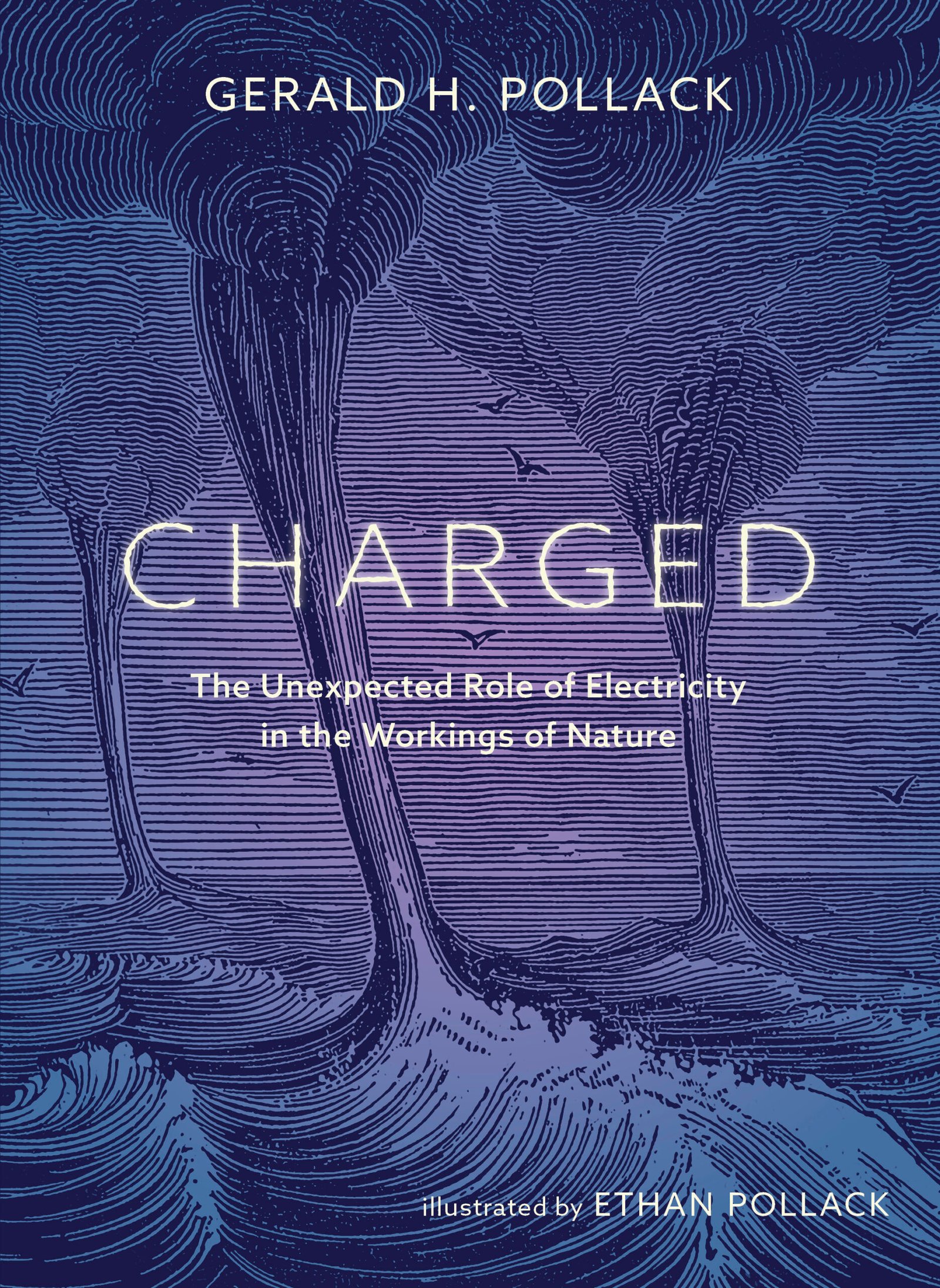
Charged
The Unexpected Role of Electricity
in the Workings of Nature
From the author of The Fourth Phase of Water
Gerald Pollack on Charged…
Discover the revolutionary concepts behind his research.
Gerald Pollack’s groundbreaking new book explores the fundamental role of electrical forces in nature. Building on his revolutionary discoveries about water, Pollack reveals how electricity powers life and the natural world.
Explore topics covered in Charged

Section I
The Charged Earth
This section deals with the charged Earth. Most of us are unaware that the Earth is anything but a bland, rotating, neutral blob. It’s negatively charged and that charge has consequences whose nature begins to be explored.

Section II
Earth Centered Dynamics
The consequences of earthly charge are profound. Here the author deals with specific consequences, including the origin of earth’s magnetic field, what propels the earth to rotate every 24 hours, and the origin of earthly wind.

Section III
Weather
Section III turns to weather. It attempts to build a paradigm of understanding using logic, experimental observation, and simple physical principles. Electrical charge plays a dominant role. The goal is to develop an accessible understanding of why it might rain, why a gentle rainfall can sometimes evolve into a terrible typhoon, and why a twister can lift a school bus.

Section IV
Gravitation
Gravitation is a force we experience relentlessly, but do we really comprehend its underlying nature? We understand that masses attract, but don’t know why. We also cannot explain anomalies such as why gravitation is weaker in some areas than others, why it’s stronger in summer than in winter, and why it changes during an eclipse. These anomalies potentially fit within a paradigm that emphasizes not the masses per se, but the electrical charges lying within those masses.

Section V
Learning to Fly
Lift entails a battle against gravitation. It’s not just birds and planes that wage this battle, but also non-winged matter including dust. Could a common principle account for that lift? Pollack reminds us that matter moving through the air acquires negative charge, and that charge repels the negative charge of the earth. Such repulsion may play a dominant role in keeping items aloft, from gliders to frisbees.

Section VI
Moving Ahead
The focus here is on forward motion. While the previous section deals with forward motion in birds and planes, here the focus shifts to entities confined to the earth: fish, and sailboats. Both can press forward against swift current or swift wind. Such feats would seem to defy Newton. In surprisingly straightforward ways, however, the author shows how electrical forces may directly produce robust forward propulsion.

Section VII
Summing Up: Unlocking Nature’s Mysteries
In accounting for the natural processes described in the book, the author offered certain electrical phenomena well recognized but not widely applied. Those processes are summarized here. The suggestion is made that they may enjoy unexpectedly broad application throughout science and technology. Pollack goes on to detail the reasons why more generally, unconventional concepts often encounter resistance, limiting the progress of fundamental science.

Curious?
Some headscratchers explained

Award-Winning Author
Recognized internationally for groundbreaking research and scientific communication
International Summit Excellence Award
Society of Technical Communication
For outstanding achievement in communicating complex scientific concepts to the public
Outstanding Scientific Achievement
International Society for Water Research
For pioneering discoveries in water structure and properties
Lifetime Achievement Award
Bioelectrochemical Society
For contributions to understanding electrical properties in biological systems